Entries by Matt Wright

The Grammarian – Great Latin mottos

Why did all the best phrases and mottos originate in Latin? From the classic “Vivere est cogitare” (‘To live is to think’ – Cicero), to the thoughtful “Verba volant, scripta manet” (‘Words fly away, writings remain’ – Caius Titus) and even down to the very modern “Vero possumus” (‘Yes we can!’ – Barack Obama…..OK, so a bit of poetic license there on my part!), the fact remains that if you want to say something profound, it’s far better said in Latin.

So I’ve compiled a short list of a few of my favourite Latin mottos – feel free to reuse or appropriate as needs be….others have done exactly the same over the years!

“Video sed non credo” – I see it, but I don’t believe it.

Caspar Hoffman after being shown proof of the circulatory system by William Harvey.

“Vincit qui se vincit”  – He conquers who conquers himself.

This is an adaptation of a phrase ‘Bis vincit qui se vincit in victoria’ meaning “He conquers twice who conquers himself when he is victorious”.

So, in the original sense, control your urge to be arrogant, smug, cruel, or vindictive when you win….and in the shortened sense, control your emotions in general. No surprise then that this is used as a motto by many schools! read more read more
How to turn a memorable phrase

What’s in a memorable phrase? It’s all in the adjective really – consider these three very different phrases:

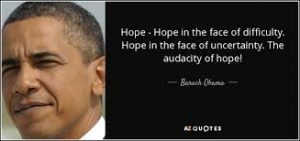
1. The audacity of hope

audacity of hope memorable phraseThis was the keynote address given by Barack Obama at the 2004 Democratic National Convention. It is important to remember that Obama was only a candidate for the Senate at the time – the Convention was the culmination of the process by which the Democratic party elected its presidential candidate; i.e. John Kerry, with John Edwards running a vice-president.
So Obama’s address was very much ‘not’ the main event. The speech itself lasts for 15 minutes and is over 2,300 words long, yet the phrase “The audacity of hope” is only mentioned once. However, it went on to become  the defining motif for Obama’s presidency. read more read more

An dummy’s guide to SEO

SEO is a word that makes many non-teccy people recoil in horror – a black box into which money can be poured with neither visibility nor certainty of financial return. 

Actually, the basics of SEO are a lot simpler than most tech experts would have you believe…

What is a search engine?

=&3=&

  • 1990: The first search engine called Archie was created.
  • 1995: Yahoo! search engine created.
  • 1996: Sergey Brin and Larry Page started work on a project to create a search engine (initially called BackRub, later renamed Google).
  • 2013: Hummingbird – Google update which focused on phrases rather than individual keywords
  • 2015: RankBrain – Google update which associated phrases with past searches with similar themes

Search engines have evolved a long way in the last 25 years, having become far more intuitive when it comes to matching internet searches with useful content. Consequently, the keyword stuffing which went on a decade ago is now a thing of the past.

SEO & SERP

Search engine optimisation is a methodology of strategies, techniques and tactics used to increase the amount of visitors to a website by obtaining a high-ranking placement in the search results page of a search engine (SERP) — including Google, Bing, Yahoo and other search engines. read more read more

GRAMMARIAN: All about (A)

Grammar (A)

Grammar: Which word to use (A)

https://www.theguardian.com/guardian-observer-style-guide-a


1. CORRECT USAGE

1.1. Similar words mean different things…

abdicate or abnegate?

abdicate renounce high office; abnegate to renounce privileges

abrogate or arrogate?

abrogate repeal, abolish; arrogate take or claim (something) for oneself without justification

abjure or adjure?

abjure renounce; adjure urge

adapter or adaptor?

adapter someone who adapts; adaptor plug

adverse or averse?

adverse unfavourable; averse reluctant

affect or effect?

when used a verb, affect means ‘to influence something’ whereas effect means ‘to bring something about as a result’: read more read more

,

BLT(*): Volunteering – Does it really help your business?

Q: BLT (*) Volunteering: Do you do it? If so, how has it helped your business?

We discussed this topic the day after the autumn budget, so the theme of ‘what constitutes a giveaway’ was fresh in people’s minds!

However, volunteering is one of those ‘giveaways’ which is surely always good…isn’t it?

Volunteering graphic

Volunteering – 3 reasons why not

 1. Volunteer, not Volun-told

In a number of professions, it is expected that you give up your time in order to benefit a charity; ie it is expected of you in your job.

Interestingly, when it comes to giving to charity (financially), the rules have become much stricter over recent years; e.g. you are no longer allowed to rattle a tin when collecting (say for The Poppy Appeal), since this now constitutes begging [I didn’t know that!]

2. When it’s for personal gain

We’re not talking about financial embezzlement, but personal experience here; e.g. to subsidise that trek to climb Kilimanjaro, to skydive from a plane, or to cycle across Europe. read more read more

2017 Word of the Year: Fake News

There were 10 words on the shortlist for inclusion in the latest edition of Collins’ Dictionary, and the 2017 Word of the Year was….fake news!

2017 Word of the Year

Source: Harper Collins

On the shortlist for the ‘2017 Word of the Year’ [note, I’ve classified them myself for ease of analysis]:

Technology

  • Gig economy: an economy in which there are few permanent employees and most jobs are assigned to temporary or freelance workers.
  • Unicorn: a recently launched business enterprise that is valued at more than one billion dollars (or an imaginary one-horned creature!)
  • Insta: of or relating to the photo-sharing application Instagram.
    • [note: ‘swipe’ and ‘contactless’ appeared in 2016…and both seem so commonplace it’s hard to believe they haven’t been around for years!]

    Politics

    • Antifa: involving, belonging to, or relating to a antifascist organisation.
    • Corbynmania: the economic policies advocated by the UK Labour leader Jeremy Corbyn. Tellingly, this word was also included on the 2016 shortlist….it seems that ‘May-mania’ doesn’t have quite the same impact!
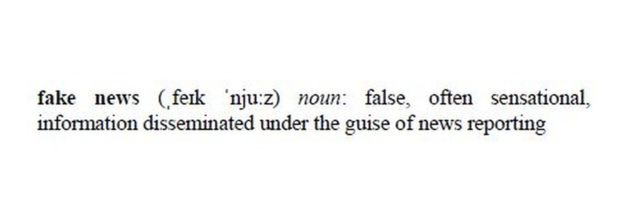
    • Fake news: false, often sensational, information disseminated under the guise of news reporting.

    Social

    • Gender fluid:  not identifying exclusively with one gender rather than another.
    • Cuffing season:  the period of autumn and winter, when single people are considered likely to seek settled relationships rather than engage in casual affairs.
      • [note: an interesting development on ‘ghosting’, which appeared in the 2016 shortlist =  ending a relationship by ignoring all communication from the other person]

      Trends & media

      • Fidget spinner: a small toy comprising two or three prongs arranged around a central bearing.
      • Echo Chamber:  an environment, especially on a social media site, in which any statement of opinion is likely to be greeted with approval because it will only be read or heard by people who hold similar views.
        • [note: Social media featured in 2016 with ‘shaming’ = attempting to embarrass a person or group by drawing attention to their perceived offence on social media]

        Conclusion

        Part of the English’s enduring appeal is its ability to keep on reinventing itself, and by looking back we can see the emergence of trends, notably the extent to which our lives are dominated by technology, which regularly seems to account for about half of each year’s shortlist.

        Previous words of the year included: read more

,

How to write an modular LinkedIn profile in just 4 paragraphs

Let’s be honest. How many times are you going to write or rewrite a LinkedIn profile? Once (when you first join)? Twice (when you look for another job)? Maybe tinker with it now and again when bored?

Anyway, I find it useful to have a LinkedIn template as a ready-reckoner, either for when I’m writing profiles for clients  or for my own (infrequent!) profile updates.

Also, the benefit of this modular approach is that your can copy and paste sections over to other social media outlets (e.g. your Elevator Pitch) and you know which paragraphs to change when necessary (e.g. when you’ve won an award or passed an exam).

Other than that, you shouldn’t need to tinker with it too much! read more read more

,

BLT (*) – Stress – when does it become unhealthy…and how do you deal with it when it does?

Stress had been rather topical recently (one of our members had recently hosted a seminar on ‘Stress Resilience’ for business coaches), so the planned discussions topic was even more ‘on trend’ today with the newswires carrying the latest survey on the negative impact of stress on the economy:

=&0=&

A ‘Thriving at Work Report’, by the CEO of mental health charity, Mind, claims that:

  • Mental health illness affects 1 in 6 people
  • 300,000 people with long-term mental health problems have to quit their jobs annually
  • The report makes 40 recommendations for ways in which support employees to remain at work
  • The most important recommendation is that all employers, regardless of size or industry, should adopt 6 ‘mental health core standards’ that lay basic foundations for an approach to workplace mental health.

Thoughts from around the Table….

It’s a very small difference between de-stress and dis-tress…at least when they’re both written down!”

I used to resent working in corporate, but it was only after I left that I did begin to appreciate the benefits of having structures and processes”

Pressure helps me to do a better job….stress is when I feel incapable of doing a good job in the first place” read more