
Coaching the coaches: what are your three biggest blogging fears?
Weblog: “Blog: a regularly updated website or web page, typically one run by an individual or small group, that is written in an informal or conversational style.”
-Source: OED
Coaching the coaches
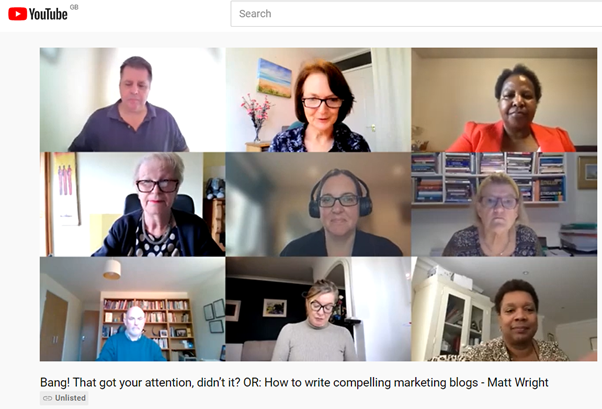
On Monday 15 November I was invited to present to an online audience of coaches by Helen Isacke of the Trusted Coach Directory. The topic was ‘blogging’, so I put together a Powerpoint presentation and off we went.
I must admit though, I’m feeling slightly more nervous than normal when it comes to writing this blog, knowing that it will be scrutinised in considerable detail by the above-mentioned audience…so I’d better be on-point!
Three burning questions from the floor
I’m not going to reproduce the blogging presentation here as there are plenty of blogs on this on my website covering all of this – what was really interesting for me were the questions and feedback
1. “I’m worried that I have to be an expert in a particular subject in order to post a blog – what should I do about this?”
Good point. The online community is full of ‘experts’, but what is the definition of an expert?“Expert: a person who is very knowledgeable about or skillful in a particular area.”For a start, this doesn’t really chime with the definition of a blog [see top of page], which suggests a more informal piece of writing.
Secondly, you don’t always have to be ‘instructing’ in a blog – you could be canvassing opinions (yes, everybody seems to have at least one online!), quoting from and referencing to a third-party article, relating your personal experience…etc.In fact, I’d veer away from the word ‘expert’ – I think ‘credibility’ is a far more attractive proposition.
Possible actions: [note – these are suggestions, which will vary according to the message & audience]
- Make it clear in the title that it’s your personal view.
- Be self-deprecating; it depends upon your audience, but sub-headings or phrases like, “People cleverer than me reckon that xxx is a great concept” or “What I’m not sure about ‘xxx is’…etc. allow you to speak your mind from a ‘non-expert’ point of view
- Avoid being didactic: this comes down to writing style, but overusing phrases of certainty – “there can be no doubt”, “it is obvious”…etc – can distance you from the reader by making you appear too much of an expert…or rather, unwilling to engage in conversation or debate.
2. “Consistency is my big problem – I tend to run out of steam or get busy with other things – I’m not sure how to get round this?”
Yup, another good point. In fact, I’d suggest that everybody runs out of steam at some point; the secret is not to let yourself get to that point with nothing left in the tank…by which I mean, always have a few finished / half-finished blogs in reserve.
Possible actions:
- The 26 letters of the alphabet: this was suggested by one of the coaches and was something I’ve used myself in the past – ascribe a keyword to every letter of the alphabet and use that keyword as a jumping-off point for a blog [note: the coach in question used these letters randomly and was emailed by one of her clients who replied that he’d grown frustrated ‘trying to crack your code’ and wanted to know what the sequence stood for!]
- Events of the year: from seasons – Easter, Christmas – to festivals – Hallowe’en, Thanksgiving – to sporting events – Olympics, World Cup – the list is endless…it really depends upon your imagination and your audience, but there should be something for everybody.
 National days/weeks: for example, I write for an electrical engineering company and there is a ‘National Apprenticeship Week’ in early February, so we make sure that we schedule our apprenticeship output carefully around this week. There are loads of prompts available on the internet: Days of the Year, National Day…etc.
3. “What is the optimal length of a blog? I find myself spending too long writing one and am not sure of the benefit I get?”
First of all don’t view a blog as a standalone piece of work, to be preserved for all time – that’s a book.
Secondly, if in doubt, I’d always err towards a shorter v longer blog (obviously depending upon the audience and platform – some blog platforms demand a minimum word length)
Thirdly, when it comes to getting benefit from a blog, think green…recycle as much as possible!
Possible actions:
- Share your blog URL on social media platforms: I came across a very informative article on writing for LinkedIn which covers this, plus another question which arose during the presentation about Google’s need for ‘unique content’.
- Write your blog with social media in mind: when writing blogs for other people/companies, I’ll highlight key phrases or quotes in a different colour for reuse on other platforms: Instagram, LinkedIn, Twitter, Facebook…etc.
- Link forwards & backwards: use ‘Related posts’ at the bottom of your blog to direct the reader to other interesting stuff you’ve written on the same topic…or to external posts on the same topic.
Conclusion

“No. Try not. Do or do not. There is no try.”
Source: Yoda, Star Wars
Yup, I think it’s as simple as that. Just do. Just write.
I’d say that it’s all about the planning stage – jot down the 5 W’s (Who, What, Where, When, Why) at the outset and it should keep you on track with your message & audience.
P.S. What do you reckon? Let me know of your blogging issues…and any tips & tricks you use to overcome them.


Thank you for posting this article.