
How to turn a memorable phrase

What’s in a memorable phrase? It’s all in the adjective really – consider these three very different phrases:
1. The audacity of hope
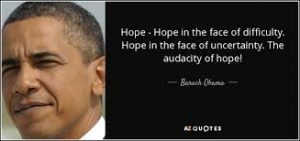 This was the keynote address given by Barack Obama at the 2004 Democratic National Convention. It is important to remember that Obama was only a candidate for the Senate at the time – the Convention was the culmination of the process by which the Democratic party elected its presidential candidate; i.e. John Kerry, with John Edwards running a vice-president.
So Obama’s address was very much ‘not’ the main event. The speech itself lasts for 15 minutes and is over 2,300 words long, yet the phrase “The audacity of hope” is only mentioned once. However, it went on to become the defining motif for Obama’s presidency.
“John Kerry calls on us to hope. John Edwards calls on us to hope.
I’m not talking about blind optimism here — the almost willful ignorance that thinks unemployment will go away if we just don’t think about it, or the health care crisis will solve itself if we just ignore it. That’s not what I’m talking about. I’m talking about something more substantial. It’s the hope of slaves sitting around a fire singing freedom songs; the hope of immigrants setting out for distant shores; the hope of a young naval lieutenant bravely patrolling the Mekong Delta; the hope of a millworker’s son who dares to defy the odds; the hope of a skinny kid with a funny name who believes that America has a place for him, too.
Hope — Hope in the face of difficulty. Hope in the face of uncertainty. The audacity of hope!”
2. An orchestra of information
What a lovely phrase! This was Olympic skeleton bob champion, Lizzy Yarnold, describing how she will be defending her title in South Korea in just over 3 months time:

“You have to keep your head. You need pinpoint focus, you need your peripheral vision filtering constantly. When you’re on the track you’re not just using your eyes, you are using the sense of smell, the pressure in your chest, you’re feeling the G-forces in your neck and chest and arms. It’s a real orchestra of information.“
3. Field of dreams
The title of a 1989 movie starring Kevin Costner, containing the equally memorable tagline, “If you build it, they will come.”
[Ray Kinsella – voiceover] “Annie and I got married in June of ’74. Dad died that fall. A few years later, Karin was born. She smelled weird, but we loved her anyway. Then Annie got the crazy idea that she could talk me into buying a farm. I’m thirty-six years old, I love my family, I love baseball, and I’m about to become a farmer. And until I heard the Voice, I’d never done a crazy thing in my whole life.”
Voice: “If you build it, he will come.”
Conclusion
So, three phrases: one from a pre-prepared speech, one from an interview and one from a film…but they all work and all linger long in the memory.
Why?
- Rhythm – ignoring the introducing article (‘the’, ‘an’…etc), the phrases are 3 words long
- Construction – adjective + linking word (‘of’ is popular) + noun
- Unusual adjective – audacity…orchestra…at any rate, something which is very visual
Try it, next time you’re struggling….for the starburst of inspiration?!



Leave a Reply
Want to join the discussion?Feel free to contribute!