
LIWF: Wine Sales Psychology – Number anchoring and the Von Resthorff effect
Last week’s London International Wine Fair ‘LIWF’ had some fascinating seminars as well as beautiful wines.
This is a summary of a section of a panel debate on wine sales psychology: How to drive people to buy more wine?
1. We anchor to known numbers
This might sound surprising: if your birthday falls at the end of the month, say the 22nd, you will tend to be anchored to the number 22…without ever consciously being aware of it.
In which case, for purchasing decisions, you will use 22 as a starting point and work down from there.
If however, your birthday happens to be on, say, the 3rd, that will become your anchor, and you will work up from there; say to £5 for a bottle of wine!
Hence, given that way that birthdays are distributed, there is a tendency to anchor to the most expensive item on the menu.
2. Stand out from the crowd
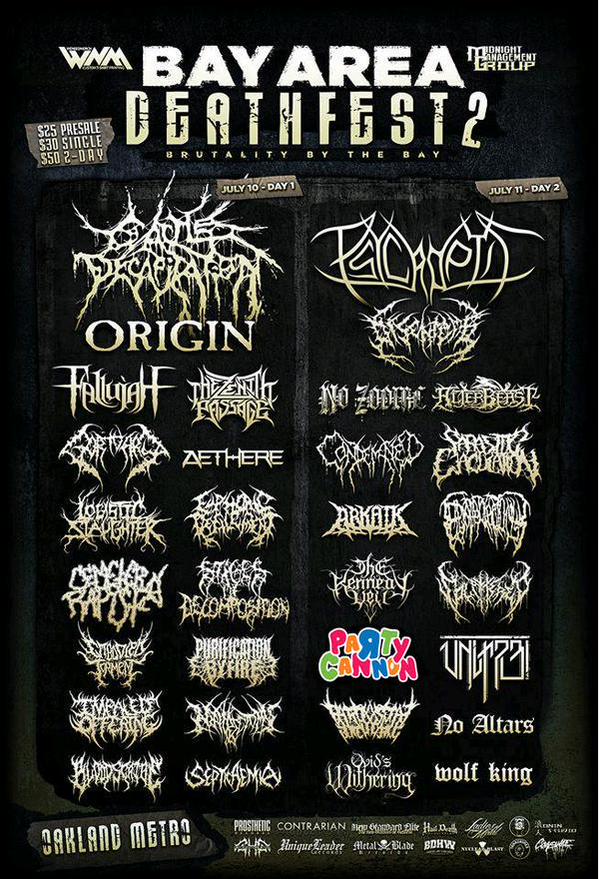
Which band name jumps out at you from this poster?
“The von Resthorff effect predicts that when multiple stimuli are presented, the stimulus that differs from the rest is more likely to be remembered”
Source: wikipedia
Hence, the death metal band ‘Party Cannon’ with its vivid colours and cartoon-ish font stands out vividly from the predominately grey and black gothic script used by all the other bands.
“Such distinctiveness, leading to the von Resthorff effect, can be generated from changing the meaningfulness or physical nature of the stimulus in some way, such as in size, shape, color, spacing and underlining.”
To relate the von Resthorff effect back to wine, take a look at a standard menu. There will be tricks used to draw attention to a wine which is more expensive than the rest or which the restaurant wants to push…they will put it in a box…or underline it…or block it out in a different colour…basically, the restaurant will do anything to make stand out from the rest of the text.
3. The number ‘9’ defines a bargain
In retail shops, most clothes tend to be priced ending in a ‘9’ rather than a ‘5’ – why should this be?
Again, it’s pyschology: £29 represents a £30 bargain…whereas £25 is perceived as a £20 spend.
The same applies to wine priced at £8.99…rather than £8.50.
And, by the by, it’s also why in magazines, you’ll see ’39 best summer breaks’ rather than ’33 best summer breaks’ – the former sounds well-thought out and complete, the latter sounds unfinished and hence somehow unsatisfactory.
4. Multiple unit pricing works
Which offer is better?
‘4 bottles of wine for £20’
or
‘Wine £5 a bottle’?
Obviously, the offers are both the same…but studies have shown that the multiple unit pricing option (‘4 bottles of wine for £20’) performed 40% better than the single pricing option (‘Wine £5 a bottle’) [source: Wansink, Kent & Hoch].
Moreover, setting a purchase limit encourages shoppers to buy more:
‘Offer limited to 12 per customer’
Wansink, Kent & Hoch, designed an experiment to advertise Cambell’s soups for $0.79 per can in a supermarket, with one aisle carrying a ‘Limit: 12 per customer’ sign, and the other aisle carrying no limit signs.
The results showed that buyers with limits purchased over twice as many cans of soup (7 versus 3.3). Reflecting back on our first example ‘1 – We anchor to known numbers’, in this instance, the brain anchors to the number ’12’ and then adjusts downwards.
Conclusion
We are far more influenced and suggestible than we might otherwise think.
So next time you’re browsing the wine aisle, just remember some of the psychological tricks detailed above and ask yourself just how much of your wine choice is down to free will?



Leave a Reply
Want to join the discussion?Feel free to contribute!