
Business Book Review : ADAPT – Why Success always starts with Failure
One of my favourite books with a plethora of fascinating real-life examples, but I’m going to concentrate on just 2 of them, which directly contradict each other:

Top-down beats bottom-up (p134)
- Economist Ben Olken set out to measure how much money was being stolen from large World Bank-funded projects
- Focused upon an Indonesian road-building project across 600 villages
- Compared on-the-ground costs, to those submitted to the World Bank = 25% of the money was going missing
- Conducted 2 experiments – top-down and bottom-up
- Top-down: villagers told the project would certainly be audited
- Bottom-up: village meetings organised to share views on the road construction and express concerns (anonymously)
- RESULT: Top-down reduced missing expenditure by 1/3rd, whilst bottom-up did nothing, as all the villagers cared about were their wages, not the inflated costs.
Bottom-up beats top-down (p44)
- After quickly invading Iraq in 2003, the US and the coalition were left with the trickier problem of how to leave Iraq afterwards.
- Top-down: US military – “The policy of the United States government is de-Baathifaction”; i.e. the removal of all Sadaam Hussein’s party members, no matter how small or insignificant.
- However, when this all started going wrong (there was nobody left to run the country), this strategy hence collapsed into “don’t get the US soldiers killed”, so they holed up in their central bases, had no contact with Iraqis, and sleep-walked into a guerrilla war.
- Bottom-up: “In the absence of guidance or orders, figure out what they should have been” – part of a sign on a command post, commandeered by David Petraeus.
- Local commanders realised that the allies needed to win over the tens of thousands of low- and mid-level employees of Sadaam’s doomed Baath regime, including administrators, police, and teachers.
- They instituted a hearts & minds offensive; e.g. patrolling without wearing Ray-ban sunglasses, growing moustaches, operating from bases within the city….etc
- RESULT: The US’s strategy may have been wrong from the outset, but it was its failure, or refusal to adapt, which compounded the situation.
- When good leaders (bottom-up military) replaced bad leaders (top-down politicians), good strategy replaced bad strategy and the problems were largely solved.
This all goes to show that the world is a complicated place – what works in one scenario, will not necessarily work in another.
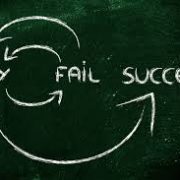
Hence why failure should be seen as a stepping stone to success….as long as you can learn from it!
——————-
Technical stuff : Tim Harford (2011), 320 pages, £4.35 online
8 Chapters
- 1 – Adapting: Toaster Project, Tetlock’s Expert Forecasting, ‘Oops, Who’s Excellent Now?’, Palchinsky’s steel mills, unemotional poker
- 2 – Conflict: How organisations learn – lessons from the US military’s time in Iraq
- 3 – Variation: Creating new ideas that matter – Spitfires, the dearth of R&D, Mario Capecchi & DNA, Search for Longitude
- 4 – Selection: Finding what works for the poor – Muhammed Yunus, PlayPumps, Randomised trials (scurvy…etc), Feedback loops, Product clusters, Big Push
- 5 – Climate Change: Changing the rules for success – FUQ’ed, Carbon footprints & Orgel’s Law, Merton & CAFE Rules, Economic bulldogs
- 6 – Decoupling: Preventing financial meltdowns – Piper Alpha & Deepwater, Safety Systems, AIG & Lehamans, Latent errors & Swiss Cheese
- 7 – The Adaptive Organisation – Guppys, Difference Machine, Timpson’s rules, Google’s corporate strategy, Christensen’s technological mudslide, Skunkworks
- 8 – Adapting and You – Movin’ Out & Tharp, correct the past, hedonic editing, discipline pluralism




Leave a Reply
Want to join the discussion?Feel free to contribute!