
BLT Discussion: Adapt – the importance of making mistakes…and learning from them

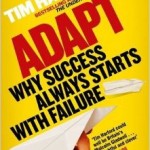
This fortnight’s BLT meeting (*) was the last in a series of the subject of Resilience. The discussion was loosely based around a book by Tim Harford – Adapt: Why Success always starts with Failure – and generated plenty of food for thought
1. Assumptions: make an ‘ass’ out of you and me
All too often, we are guilty of doing something just because “it’s always been done that way”, without ever questioning why? This lovely story from around the BLT table illustrates perfectly the danger of relying on such assumptions:
A young Italian woman was making a family recipe for the first time, one that had been passed down through the generations.
The recipe called for a large chicken, and specified that the top 2 inches of the chicken should be removed and and discarded. Puzzled that such good chicken should go to waste, the woman phoned her mother and asked her the reason why?
Her mother replied that she didn’t know – that was how her mother had taught her.
Undeterred, the young woman phoned her grandmother and asked her the same question – she replied that she didn’t know either – that was how her mother had taught her.
Luckily (being from a large Italian family!), her great grandmother was still alive. She phoned her to ask her the reason why the top 2 inches of the chicken should be removed in the recipe.
The great grandmother replied, “Because our oven was too small.”
2. Be wary of cross-cultural misunderstandings
This is an example taken from the ‘Adapt’ book.
The best of Western intentions do not always translate into the desired effect, especially when it comes to international aid. Initially, pictures of children of ‘enjoying themselves’ on PlayPumps were hailed as an indication of the project’s success…the reality was very different though.
PlayPump: a pump powered by a children’s roundabout, drawing clean water from a well without the need for unreliable electric pumps. Pictures of children enjoying themselves on the PlayPumps abounded prompting more and more aid agencies to support them.
ASSUMPTION: children would play on the roundabouts and clean water then magically appears as a by-product of innocent play = a win-win situation.
REALITY: it takes over 6 times long to fill a 20-litre bucket with a PlayPump (3 minutes 7 seconds) than a traditional hand pump (28 seconds).
The locals unanimously preferred the hand pumps, particularly as it was the mothers who had to spin the roundabouts by hand to work the PlayPumps…the children, however, would jump on and start to play as soon as anybody pointed a camera at them, since that was their culture!
3. Adapt…or die
Nowhere is the need to learn from one’s mistakes more keenly felt than in the theatre of war. Harford’s book dwells extensively upon the lessons learned (albeit slowly) from the Iraq War.
In many respects, the Iraq War of the 2000’s bore all the echoes of the disastrous Vietnam War from the 1960’s: a strict chain of command, a united team all pulling in the same direction, and a ‘big picture’ view produced by the refined analysis of all the available information. In other words, no room was left for dissenting voices or innovation from the front line – everything was driven from the centre, located 6,000 miles away in Washington DC.
“Just because you invade a country stupidly doesn’t mean you have to leave it stupidly”
This was the title of one (very dissenting article) packaged as a set of practical tips, written ‘on the ground’ and circulated by email amongst the front line troops without the knowledge of the military top brass.
It was just one of a number of initiatives that helped to turn the war – establishing small outposts in the Iraqi cities rather than retreating behind one huge central compound in the desert, role-playing difficult social interactions at mocked-up checkpoints and analysing the subsequent videos…etc.
“We willingly implement lessons learnt at the bottom end, because changing and adapting low-level tactics saves lives. However, we rarely adapt and implement lessons learned at the top end.”
-British General serving in Iraq
Conclusion
Those were just a few of the examples discussed during the meeting. Other observations from around the table on how to learn from ‘failures’ included:
- The ‘Wash-up meeting’: one of the BLT members is instrumental in organising the Kop Hill Road Climb, a huge motor event based in Princes Risborough every September. There are a huge number of moving parts, so in the week after the event, a ‘wash-up meeting’ is held between all members of the management committee. This records what went well, what didn’t, and ensures that the relevant lessons are duly recorded so that any ‘mistakes’ are not repeated.
- The Personal Diary: there is a delicate balance between the need for persistence & resilience versus having the confidence to walk away; invariably, this only comes from experience, but knowing what your rationale was at the time is vital, hence the Personal Diary
- ‘The 6 Thinking Hats’: [see last fortnight’s topic] the tendency to be overly optimistic or pessimistic can cloud our judgement when assessing how to adapt to a setback – by compartmentalising one’s thinking (either individually or as a group) a better understanding of how to proceed can be reached.
“In the absence of guidance or orders, figure out what they should have been…”
-part of a sign on a command-post door in West Baghdad
(*) BLT is a free fortnightly networking group that meets from 7:15-8:45, every other Thursday at The George & Dragon, Marlow.
For more details, please leave me a message – new networkers are always welcome.
The next meeting is Thursday 27th September.




Leave a Reply
Want to join the discussion?Feel free to contribute!