
Throw them to the wolves!
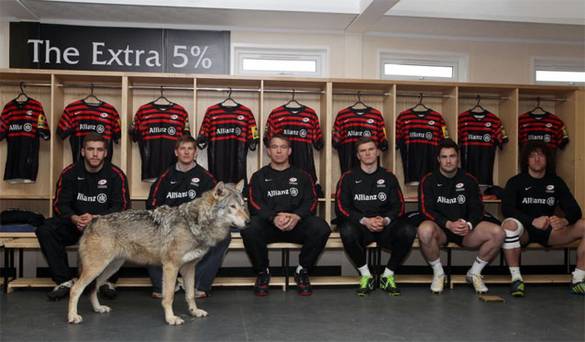
So, you’ve got a squad of 30 hard-bitten rugby professionals, who have been coached all of their lives, and have seen just about every technique in the book. How do you grab their attention, and inspire them to get your message across?
Paul Gustard is a former flanker who played for Leicester Tiger and Saracens, but is now better known as the defence coach for the national England side.
Aside from all the technical aspects, Gustard has proved particularly adept at getting his message across by putting players into the right emotional frame of mind.
Which usually means thinking outside the box.
3 of Gustard’s memorable sessions
1. Bring on the wolves
The wolves were on two boxes behind me as I spoke, with handlers and on a chain, giving off this real feral smell….
The visual deterrent.
A major component of Saracens’ success (where Gustard previously coached) was their their highly effective “Wolf Pack” defensive system.
It was a fairly simple system, but crucially relied heavily upon teamwork to function efficiently – players were given free licence to respond to the attack in front of them (sometimes they drifted, sometimes they blitzed), but crucially, whatever decision they took, they knew the rest of the defensive line would be right behind them.
Just like a wolf pack.
Hence, Gustard decided to bring real wolves into an England training session when he was appointed defence coach, to get his point across….
I want to see players’ reactions, I want to see them respond.
2. The Scorpion and The Frog
‘Blame me not,’ said the scorpion, in a supplicatory tone, ‘it is not my fault; it is that of my nature; it is a constitutional habit I have of stinging.’
The story.
In this instance, the scorpion begs the frog to carry him to safety from a flood, but once on his back proceeds to sting him, and they both drown.
The moral of this fable is that something/somebody’s fundamental nature will not change.
In rugby terms, this means that certain teams (e.g. Springboks = overtly physical) will revert to playing in certain ways, and that English players will have to prepare themselves to deal with that.
3. The pocket mirror
The prop.
Each player was handed a pocket mirror whilst Gustard recited the poem, ‘The Guy in the Glass’.
The point here being that you have to be true and accountable to yourself:
….it isn’t your Father, or Mother, or Wife,
Who judgement upon you must pass.
The feller whose verdict counts most in your life
Is the guy staring back from the glass.
Motivating means being authentic
However, as Gustard himself says, these motivational devices are not ends in themselves – they are designed to grab attention and to engage listeners, otherwise they merely become ‘cheap tricks’.
So next time you’re trying to get your point across in a presentation, think about how you could approach this from a different point of view in order to connect with the audience….which doesn’t necessarily bring a live wolf into the equation!
It can’t always be whistles and bells – or wolves – and you can’t always reach everyone every time if you’re coming at theme from left-field. But if they know your intentions are honest, then you’ll get them to a good place.



Leave a Reply
Want to join the discussion?Feel free to contribute!