
I suppose you can’t always have your cake and eat it….
Hmmm….well it does take the occasional ‘bad’ literary festival session to make you appreciate the ‘good’ ones, doesn’t it?
The Oxford Literary Festival ‘OLF’ (*)
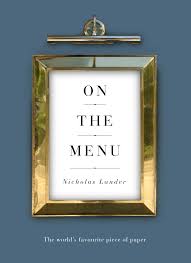
On the face of it, this was a unique chance to share the experiences of Nicholas Lander (**), a food critic with impeccable credentials, who would obviously use the evolution of the restaurant menu (‘On the Menu’ ) as a backdrop to a series of hilarious anecdotes and fascinating insights into the beguiling world of high-end cuisine.
Sadly, it just didn’t work out like that….

The origin of the restaurant
First some scene setting from Lander, with a quick whizz through his book (and I do mean quick, no more than 15 minutes tops).
The popular concept of the restaurant is widely-accepted to have begun in post-revolution Paris, with the abolishment of the guilds and the overthrow of the former aristocracy; this forced cooks to set up ‘on their own’ during the 1800’s and fend for themselves:
…..before a ‘restaurant’ was somewhere to eat, it actually was something to eat. The word ‘restaurant’ meant a rich, highly-flavored soup thought to have the ability to restore one’s strength. A ‘restaurateur’ was someone who served these consommés…..[hence] the word restaurant came to mean an establishment that sold restorative foods.
The original restaurant menus were simply long lists of the foods available; however, these weren’t as complicated as they appeared, probably closer in style to the modern-day Indian menu where the same type of sauce is applied to many different dishes.
According to Lander:
- The ‘high point’ of restaurant menus was in 1940’s USA when graphic design was it its most innovative
- Restaurant menus should be simply written and excessive descriptions of ‘provenance’ should be avoided (St.John’s in London was provided as an example of good unfussy menu writing)
- They should follow a prescribed order – Soups, Salad, Fish Starters…etc
- The use of colour should be encouraged to break up menu items; e.g. random dishes picked out in red font
- Certain chefs were applauded for their vivid use of imagery on menus; e.g. Heston Blummental’s ‘Alice in Wonderland’ theme
As good as it got
However, that was about it from Lander. Done. Plates cleaned away. Service over.
At this point, the interviewer (who happened to be Lander’s editor at the FT – I’m not sure that helped matters much?) took over and asked a series of pre-prepared questions. These were largely met with short answers followed by silence. No elaboration, no juicy titbits of gossip, no interesting stories or amusing anecdotes.
After the interviewer exhausted her list of 10 pre-prepared questions (in as many minutes), she threw it open to Q&A from the floor, more in desperation than anything else, like a a person bobbing around in the sea scanning the waters for something to cling onto.
Luckily, the OLF audience had plenty to say for itself, with a fair few restaurant owners and foodies alike in the audience
Q&A
Here’s a brief selection of some of the questions posed:
- Q: New trends? A: Sharing dishes are here to stay – they are very cost-effective
- Q: Threats to the printed menu dying out? A: No, ‘Ipads feel wrong’ when ordering (although data gathering by ordering electronically was highlighted as a major advantage by the audience member in question)
- Q: What elements should a good menu have? A: The day’s date, some use of colour, proper English, and 6-8 dishes per Starter, Mains, Dessert (some innovative restaurants go one further; e.g. Quo Vadis include the day’s temperature)
- Q: Biggest surprises? A: That chef’s have no Intellectual Property ‘IP’ protection over their dishes, although some chefs are better than others at referencing.
What could have been done better?
One only has to browse the internet to come up with articles espousing the psychological tricks employed with restaurant menus, some of which Lander alluded to but failed to expand upon.
For example:
- Give food an ethnic label to make it sound more ‘authentic’
- We generally scan menus in a ‘Z-shaped’ fashion but our eyes are easily distracted by boxes, pictures, or colour (see Lander’s point above)
- The paper the menu is printed upon influences our perception; e.g. rough-hewn paper implies an artisinal quality, raising expectations of the food
…..etc
Overall, the shame of it was there was so much knowledge that could have been imparted….but wasn’t.
Oh well, some you win, some you lose!
Other Reviews from the OLF
Lucy Kellaway, Journalist & (soon-to-be) Teacher http://www.nobleword.co.uk/lucy-kellaway/
Alexander McCall Smith, Author http://www.nobleword.co.uk/alexander-mccall-smith-oxford-literary-festival/
(*) The Oxford Literary Festival (Sat 22nd Mar – Sun 2nd Apr 2017) organised by Blackwell’s, features hundreds of authors speaking at venues across Oxford.
(**) Nicholas Lander has been the restaurant critic for the Financial Times for over 20 years, having previously run L’Escargot restaurant in Soho in the 1980’s.


Leave a Reply
Want to join the discussion?Feel free to contribute!