
BLT: Ideal Client Case Study – what does yours look like?
Describe your best Client Case Study? What does success look like? How do you go about replicating this?
These were the questions pondered at the latest BLT meeting.
STARTER QUESTION: WHO IS YOUR IDEAL CLIENT?
The ‘Starter Question’, posed to all the BLT participants around the table to at the outset of the meeting, is frequently unrelated to the main topic…but today it wasn’t! Hence, it helped to set the scene nicely for the core issue of ‘Best Case Study’.
Responses – Who is your Ideal Client?
• Clients who are prepared to accept my advice.
• Those who value ‘good’ work.
• Clients who don’t know what they want so they can allow themselves to be helped (coaching).
ALTERNATIVELY
• Clients who do know what they want so they can instruct me properly!(copywriting)
CASE STUDIES – REASONS FOR YOUR BEST CLIENT EXPERIENCES
• Start with the ‘why’ – always remember it is a problem you are trying to solve. [see ‘Start with ‘Why?’ below]
• Be specific about what you do – it helps to organise yourself + helps others to remember and refer you.
• Be vocal about what you do – often one job flows into another as trust is built with a client.
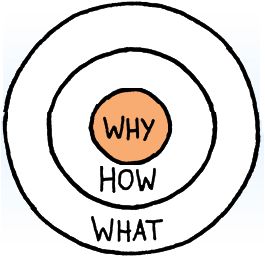
SIMON SINEK: START WITH “WHY?”
Sinek’s central thesis is that inspiration is a much more powerful way to influence human behaviour than by manipulation, hence the importance of the ‘Why‘ statement at the outset.
Taking the standard 5 W’s + How model (Who, Why, What, Where, When) which is the standard checklist for marketing communications, Sinek focuses exclusively upon the Why, How and What.
Why – This is the core belief of the business; it’s why the business exists.
How – This is how the business fulfills that core belief.
What – This is what the company does to fulfill that core belief.
I’ve taken material from the following blog – https://blog.hubspot.com/customers/3-takeaways-from-start-with-why – and edited it in order to explain how to implement ‘Start with “Why”‘ in practical terms.
3 Key Takeaways for Inbound Marketers
1. Take a step back and use “why” to think about your own business.
Remember: People don’t buy what you do. They buy why you do it.
So, it is essential to first understand the core purpose of your business (which is not about making money), and then think about how you market your products or services accordingly.
2. Incorporate “why” into your marketing copy.
Try to always start any marketing communication with “why” at the very outset (the value of what you’re promoting), before moving onto the “what” or the “how” (which represent the details).
This sounds far less “salesy” as it hands the choice to the customer at the outset; i.e. if your customer agrees with your “why” principle then the “what” and “how” are merely there to help them achieve their objectives.
You are helping them rather than selling to them.
3. Redefine your buyer personas.
Before you do anything else, first think about your buyer personas.
Perhaps you are a small business with large competitors and your customers are loyal to you because they like to support the underdog. Perhaps you’re committed to making the world a better place, and your customers love you because they believe in your cause
Whatever the reason, address the underlying motivation that drives your customers’ purchasing decisions and they will continue to advocate you.
CONCLUSION
In all the “Ideal Client Case Studies” from the BLT members around the table, there was a commonality, a meeting of values – the clients respected and valued the work undertaken.
Hence, the “why” did seem to be of critical importance, as per Simon Sinek’s seminal book.
Consequently, you could do worse than implement the “3 Key Takeaways” if you’d like to finesse your marketing copy to attract more Ideal Clients.


Leave a Reply
Want to join the discussion?Feel free to contribute!