
BLT: Fake news! How does the media influence you?
Definition: “Fake news is a neologism often used to refer to fabricated news. This type of news, found in traditional news, social media or fake news websites, has no basis in fact, but is presented as being factually accurate.”
– Cambridge English Dictionary
So it’s official – fake news is everywhere!
However, if fake news is everywhere, how do we identify it and how do we avoid it…or are we happy to go along with it?
Fake news – a potted history
Fake news is not new. In fact it’s been around ever since printing was invented.
1600: In the 16th& 17th centuries, pamphlets would circulate telling stories of strange beasts or other-worldly occurrences, such as the discovery of a monster with “goat’s legs, a human body, seven arms and seven legs” (1654, Spain). Did people buy them? You bet they did!
1800: As newspapers came on the scene in the 1800s, there was a need for journalistic integrity, at least for the traditional newspapers who needed to sell copies to their readership and who had titles/reputations to protect. However, newspapers which were funded primarily by advertisers held no such qualms – for them, it was a case of quantity over quality.
For example, in 1835, readers of the New York Sun were told of “giant man-bats [who] spent their days collecting fruit” and “goat-like creatures with blue skin” [Source: 1843magazine.com] These creatures had been observed living on the moon by an eminent astronomer out in South Africa through his amazing new telescope and the New York Sun’s daily circulation duly trebled as people rushed to buy each day’s new edition. There was one small hitch though – the stories were completely fabricated by the Sun’s editor.
1900: Fast forward to the late 1900s and not much had changed. Certain publications became renowned for their fantastical stories – “World War 2 bomber Found On Moon”was one of my personal favourites from The Sunday Sport (1988). However, you didn’t read The Sunday Sport (founded in 1986 by David Sullivan, a soft porn publisher) for its news stories – for that, you would pick one of the quality daily newspapers (Times, Guardian, Telegraph…etc) in the pre-internet days.
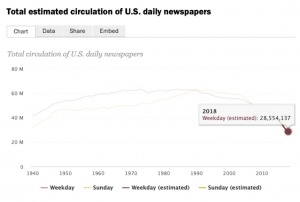
2000: Today though, newspapers no longer hold sway. In the USA, since the 1990 peak, daily newspaper sales have more than halved from over 60m to below 30m. The internet is now the prime source of news for most Millenials.
So, in summary:
| THEN | NOW |
| Newspaper | Internet |
| Story | Headline |
| Readership | Clicks |
| Bundle of stories | 1 story |
Thoughts from around the BLT table
- Only a couple of attendees read a physical newspaper every day
- BBC or Radio 4 were the main news sources
- One person admitted to using Twitter (mainly for specialised news feeds)
3 BLT tips for avoiding fake news
- Adopt a critical mindset
- Check your source
- Examine the facts
However, this assumes that you actually want to distinguish fake news from real news. This ignores the effect of confirmatory bias, whereby we will click (because it’s so easy) on something which matches our values/ideas.
For example, in the USA, the Trump administration has been synonymous with fake news stories. Is this a case of Trump supporters pedalling such lurid claims as Hilary Clinton selling weapons to the Islamic State or the pope having personally endorsed Trump? Or, is it because Trump supporters are more likely to like or retweet links, thereby generating more money for the articles which direct readers to websites…rather like the New York Sunexample above?
Likes and Retweets
It’s all down to psychology.
Take Facebook: Mark Zuckerberg (the founder) apparently resisted the ‘Like’ button for years because he worried that users would use this “lower-impact feedback” method more often than “higher value interactions” such as reposting or commenting [source: New Statesman].
However, once the ‘Like’ button proved successful, there were no plans to introduce a ‘Dislike’ button to present a balanced view. This is because negative feedback traditionally drives users away, hence a thumbs-down icon would discourage posting. Which when you have an advertiser-driven model which depends upon higher usage isn’t exactly what you want!
Conclusion
Fake news has been around for years – it’s just that it isn’t located in convenient silos anymore to make it easy to identify; it can be found just about anywhere on the internet.
Why? Because the internet thrives on love or hate, not indifference – this is what drives people to interact more, click more, and generate more money for the internet platforms. In other words, fake news isn’t usually personal – it’s just business.
With the BBC and Radio 4 largely free of fake news (journalistic integrity, quoting sources..etc), the BLT members considered themselves to be largely uninfluenced by fake news…although there’s always that sensational headline at the corner of the web page which invites you to click to find out why…no, best not go there!
Related articles


Leave a Reply
Want to join the discussion?Feel free to contribute!