
Life doesn’t get easier or more forgiving, we get stronger and more resilient.
― Steve Maraboli
There was a lot of the ‘usual’ common sense stuff in this book – Resilience: How to cope when everything around you keeps changing (Liggy Webb); about how to become more resilient by believing in yourself, taking care of yourself (exercise, diet, sleep..etc), asking for support, writing down plans…etc.
There were also some ‘less-obvious’ common sense suggestions: ’embrace probortunities’ (a problem or opportunity, depending upon your point of view), ‘chunk up change’ (break down big changes into smaller steps) and ‘keep your powder dry’ (stick to familiar routines in the midst of change wherever possible).
However, for the purposes of this blog, I’m going to focus upon the sections that broke new ground with me.
Chp 3: Emotional Intelligence
I have learned now that while those who speak about one’s miseries usually hurt, those who keep silence hurt more.
– C.S. Lewis
The term Emotional Intelligence (EI) was first used in 1966 in the world of psychology although its origins can be traced back to Darwin’s work on the importance of emotional expression for survival.
The five key elements of EI are:
• Self-awareness – understanding your emotions and not letting them overwhelm you
• Self-regulation – limiting the extremes of your emotions
• Motivation – a willingness to defer immediate results for long-term success
• Empathy – being able to ‘put yourself in somebody else’s shoes’
• Social skills – a willingness to help others to develop and grow
Chp 4: The Grief Cycle Model
It seldom happens that a man changes his life through his habitual reasoning. No matter how fully he may sense the new plans and aims revealed to him by reason, he continue to blog along in old paths until his life becomes frustrating an unbearable – he finally make the change only when his usual life can no longer be tolerated.
– Leo Tolstoy
Elizabeth Kubler-Ross was a Swiss-American psychiatrist who wrote a book called ‘On Death & and Dying’ which included the Grief Cycle Model detailing the six stages that individuals go through when processing grief (or change).
• Shock
• Denial
• Anger
• Bargaining
• Depression
• Acceptance
Knowing this cycle and knowing yourself [see Chp 5 below] will help you to understand how you react in certain situations or stages of change.
Chp 5: Personality Types
The term ‘Psychometric testing’ is derived from the Latin term ‘measurement of the mind’. A well-known psychometric test to determine personality type is the Merrill-Wilson model.
The four personality types are: Driver, Expressive, Amiable, and Analytical. There are two variables to identify any personality: are they factual or relationship-driven and are they introverted or extroverted?
Driver — Fact-Based Extrovert: independent, decisive and determined BUT can be impatient, domineering and controlling.
Analytical — Fact-Based Introvert: expressive and imaginative BUT can be overwhelming
Amiable — Relationship Introvert: thoughtful, disciplined and thorough BUT can be perfectionists and bogged down in minute detail
Expressive — Relationship Extrovert: supportive, patient and diplomatic BUT can lack the ability to be assertive and reluctant to make decisions.
Note: Most people will have major and minor type. Identify the major type and talk to that type.
Chp 5: The Cool down model
How to defuse a conflict situation:
• Listen: reduce stress; somebody in conflict mode is on transmit
• Sympathise: simply saying “I’m sorry you feel that way” can help to defuse
• Empathise: there are three sides to every situation – your perspective, their perspective, and a joint perspective
• Ask q’s: what is the root of the problem
• Agree a course of action
Chp 6: Edward de Bono Thinking Hats
Ah, I loved this particular, so much so that it has become the subject of its own blog.
Chp 9 – Let go of emotional baggage
If you are going through hell, keep going.
– Winston Churchill
 Kicking the past around is not only exhausting, it can be really boring, so let go of your negative past – learn the lessons that you need to learn and move on!
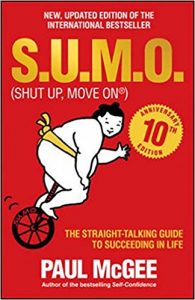
In Latin, ‘sumo’ can mean ‘choose’, which is what you can do in any given situation.
The book ‘SUMO:Shut up and Move On’ (Paul McGee) was referenced as an invaluable guide in this respect.
Chp 10: Develop SMART goals
Humans have a built-in, goal-seeking, success mechanism that is part of the sub-conscious mind and which is constantly searching for ways to help us reach our targets and find answer to our problems.
-Dr Maxwell Maltz , Psycho-Cybernetics
In other words, we work better when we have clear targets:
• Specific – if your target is vague or ambiguous, your success mechanism becomes confused
• Measurable – what gets measured gets done
• Achievable – for short-term targets, your probability of achieving your goal should be 80%, longer-term targets can be less as you will have more time to develop the necessary skills
• Recorded – reinforce your goals with positive images
• Timed – keep your goals relevant and prevent excuses
Our greatest glory is not in never falling, but in rising every time we fall.
– Confucius


