Six Top Tips for Event & Conference Writing
You know how it is with conferences – it’s all a bit chaotic, all very time-pressured, plus you’re usually having to multi-task at the same time. All in all, not the most conducive environment for thoughtful and reflective writing.
Fear not though, here are some guidelines to help you cope and make sense of everything admits the chaos
1. Preparation – pre-filling and file organisation
- Get hold of a conference schedule beforehand – fill out the standing details on your formatted sheet (see point 2 below):
- Speaker name
- Speech title
- Time, location (if appropriate)
- It may sound rather basic, but it will save you valuable minutes when everything is ‘happening’ all around you.
- There can often be more than one writer covering a conference, especially if there are simultaneous seminars taking place. Therefore, if sharing documents ‘live’, make sure that you’ve pre-formatted your file structure (be it in Dropbox, Google Docs or iCloud) so that you know where your documents are kept and what is yours.
2. Save time – create a modular structure
Time is not your friend during a conference so you have to be mean with it and cut corners wherever possible – this is where a modular structure is vital, since speakers don’t necessarily arrange their speeches in the most logical or chronological fashion.
At the recent B4 2018 InOxford conference, I used the following format:
- Twitter headline quote – something attention-grabbing, 140 characters or less, that can be shared on social media with a link to the write-up
- Elevator introduction pitch – a slightly longer introduction covering the 5 W’s – who, where, when, why, what – that can also be shared.
- 3 Key Takeways – a bullet point list detailing the three most important points (it could be four, it could be five…it all depends upon the speaker and the audience for whom you’re writing
- Conclusion and Call to Action – does the speaker have a book, a seminar, an offer…what was the point of the speech.
Link to B4
3. Guidance – use arresting sub-headings
Try to always imagine you’re writing for a newspaper or magazine audience – your sub-headings should both entertain and inform.
4. Format – whitespace and bullet points
Try to think ahead about the format in which your write-up will be presented – will it be available purely on line, available as a pdf, or printed in hard copy?
Things to think about:
- The final printed format – if your write-up is to be printed, a newspaper format will often be used; i.e. two, three, or four columns on a page, so keep paragraphs short and to the point.
- Images – there will often be photographers at conferences – could a picture help illustrate your story? If so, leave instructions for it…and room to insert it afterwards.
- Bullet points – great for taking notes down quickly and a superb visual aide to breaking the page up for the reader.
5. Highlights – italicise and embolden
Always make it as easy for the reader as possible:
- Style Guide – if there is more than one writer, it helps to have a Style Guide in advance, so that the output is consistent.
- Italicise – specify in the Style Guide where & when to use italics; e.g. for the title of a book, How to Win Friends and Influence People [italics, no single quotes].
- Embolden – all sub-headings, names of people, places…again, refer to the Style Guide beforehand so you know what you’ll need to highlight.
6. Emphasise – enlist the help of ‘pull quotes’
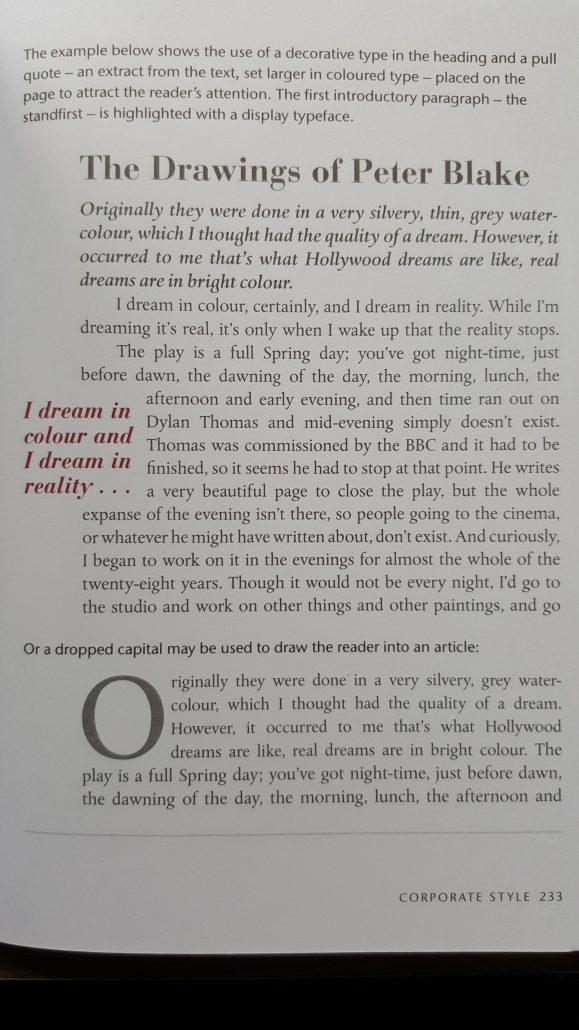
Pull quotes isolate the most important quotes or sections of text.
This is an example of a pull quote
They are also visually arresting, breaking up the text and helping to guide the reader’s eye through the copy.
Below is another example of a pull quote, set against the main body of text in a different colour to make it stand out [Source: Typographic Style Handbook]
Conclusion
There you have it – as long as you’ve got an idea beforehand of what you want to achieve and a plan to enact that, the writing more or less takes care of itself.
Well, perhaps there’s a little bit more to it than that – if in doubt, hire somebody in