This year’s Oxford Literary Festival took place 17-25 March and included the great and the good of the literary world: Horowitz, Tomalin, McEwan, Pullman…writers for whom mere surnames alone are enough to announce their presence.
However, they do say never meet your heros (last year’s lecture by Alistair McCall Smith being a notable exception) so I’ve often found that the more interesting events at these events comprise either a lesser-known writer or a more obscure topic. This year’s highlight for me was the Oxford Poet’s Walk…perhaps not such an obscure topic, but doubly fascinating when illuminated by walking in the footsteps of poets of old, learning the story behind their poems, and hearing some of the lesser-known poems for the first time.
To cover as much ground as possible, rather than a chronological recital, I’ve re-categorised the poets draw out a few of the more interesting themes.
1st World War (1WW) poets
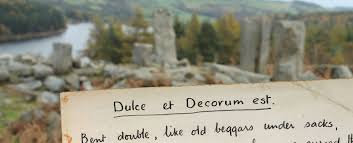
Many of the 1WW poets went to Oxford or Cambridge. They were responsible for charting the savageries of war and many of them were killed in the process: Wilfred Owen (Anthem for Doomed Youth), Rupert Brooke (The Solider), and Issac Rosenberg (Break of Day in the Trenches).
Julian Grenfell (Balliol) was different though – he went on to become a professional soldier, not a conscript like most of the others, and loved war: “The fighting-excitement vitalizes everything, every sight and action. One loves one’s fellow man so much more when one is bent on killing him.”
Nevertheless, Grenfell was among 16 Great War poets subsequently commemorated on a stone in Poet’s Corner, with an inscription by Wilfred Owen which reads:
“My subject is War, and the pity of War. The Poetry is in the pity.”
Some did survive 1WW – Edmund Blunden (Queen’s) Robert Graves (St John’s – who went on to write I Claudius) and Lawrence Binyon (Trinity) who penned probably the most-widely quoted war poem, For the Fallen, 7 stanzas long but only the 4th stanza, is ever quoted nowadays, better known as The Ode of Remembrance:
“They shall grow not old, as we that are left grow old:
Age shall not weary them, nor the years contemn.
At the going down of the sun and in the morning
We will remember them.”
2nd World War (2WW) poets
Whereas the 1WW poets all served in the trenches and depicted the visceral, brutal, hand-to-hand aspect of war, the 2WW was far more mechanised, and led to a lesser output of recognised verse.
That is not to say there weren’t some fine poems produced, including probably my favourite poet, Keith Douglas (Merton); here’s the 1st stanza from How to Kill:
“Under the parabola of a ball,
a child turning into a man,
I looked into the air too long.
The ball fell in my hand, it sang
in the closed fist: Open Open
Behold a gift designed to kill.”
Post-war poets
The list of great post-war poets produced by Oxford is extensive – Auden, MacNeice, Betjeman, Larkin – but rather than recite their (very well-known) works, it’s worth having a look at their creative influences whilst at Oxford.
Philip Larkin and Kingsley Amis became friends during their first year at St John’s – “For the first time I felt myself in the presence of a talent greater than my own” (Larkin on Amis) – bound by a universal love of jazz and a hatred of the Old English poetry they were supposed to study on their course. Following university, Amis struggled as a poet before Larkin helped him to knock his novel Lucky Jim into shape – apparently Amis began Lucky Jim as a book about Larkin but Larkin’s advice was to make Jim more like Amis.
In 1925, WH Auden (Christ Church) was at Oxford at the same time as other poets such as Cecil Day-Lewis (Wadham), Louis MacNeice (Merton), and Stephen Spender (University). These four were commonly referred to as the Auden Group for their left-wing views, although the existence of the group was a journalistic myth – they were only ever in the same room once, although individually, they all either collaborated with or referenced each other.
Failed poets
These days the prospect of a Third (‘Douglas Hurd’ in rhyming slang – rather unfair as he actually received a First ‘Geoff Hurst’ in History from Trinity, Cambridge!) fills most students with absolute horror. However, back in the day it was not all that uncommon, in fact, failure was a real option:
i. Failed degree
- AE Houseman (St John’s) : after enduring unrequited love with his roommate, Houseman failed his finals and went to work in the Patent Office.
- John Betjeman (Magdalen) – described his tutor C. S. Lewis as “unfriendly, demanding, and uninspiring as a teacher”, who in turn thought of Betjeman as “an idle prig”, not helped by the fact Betjeman would turn up to tutorials in slippers carrying a teddy bear (incidentally, this image of Betjeman formed the inspiration for Sebastian Flyte in Brideshead Revisited – Evelyn Waugh was a friend and contemporary).
- Stephen Spender (University) – claimed to have never passed an exam at Oxford. He left without taking a degree and moved to Hamburg, collaborating frequently with Christopher Isherwood (a close friend of Auden’s).
ii.Gained a Third
- WH Auden (Christ Church): won a scholarship studying science and engineering but switched to English in his second year.
- Evelyn Waugh (Magdalen): when asked if he played any sports for his college, he famously replied that he “drank for Hertford”.
The final lines from Betjeman’s poem Autumn eloquently sums up his dissatisfaction with Oxford:
“But in case you should think my education was wasted
I hasten to explainThat having once been to the University of Oxford
You can never really againBelieve anything that anyone says and that of course is an
assetIn a world like ours;
Why bother to water a garden
That is planted with paper flowers?”
Related articles:
http://www.nobleword.co.uk/the-burning-of-books/